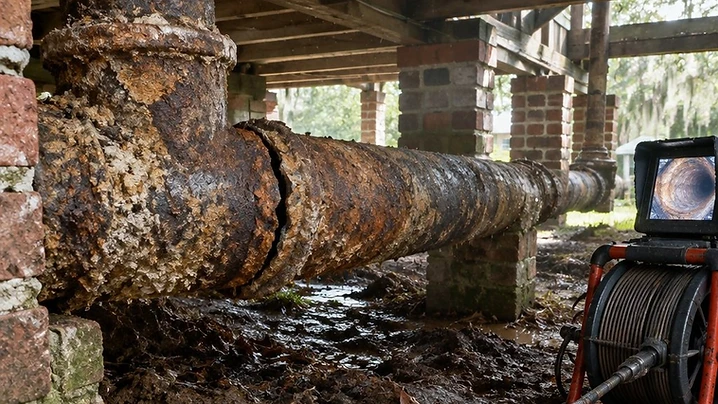
Cast Iron Sewer Lines Under Older Lafayette Homes | Parish Plumbing
If your house was built before the mid-1970s, there is a good chance the pipe carrying everything out of it is cast iron. If it was built earlier than that, some of the lateral out to the city main may be clay tile, and in a small number of cases the infamous tar-paper pipe known as Orangeburg.
These materials were not bad choices. They were the standard, and they served these neighborhoods for generations. They are also at or past the end of their useful life, which is why the same drain keeps backing up no matter how many times someone snakes it.
How cast iron actually fails
Cast iron does not rust through evenly. Inside a sewer line, the top of the pipe carries gases and the bottom carries water and solids. The top corrodes and scales, and the bottom wears.
The pattern you get after 60 years is a pipe that has lost wall thickness at the crown and developed a channel at the invert, where the flow has been scouring the same path. Look inside with a camera and it does not look like a pipe. It looks like a creek bed.
The joints are the other failure point. Cast iron sections were joined with lead and oakum, and roots find those joints. Once a root gets in, it grows.
The signs, and the one that matters
- The same fixture backs up repeatedly, even after snaking.
- Multiple fixtures drain slowly at the same time, which points to the main and not a branch.
- Gurgling from a floor drain or a tub when the washer runs.
- Sewage smell in the yard or under the house.
- A soggy, unusually green strip in the yard along the line.
- A cleanout that will not stay clear.
The one that matters: repeat backups at the same location after professional clearing. That is not a clog. That is a pipe problem, and every snake just costs money and buys a few weeks.
The camera is the only honest diagnosis
You cannot choose a repair from the surface. A camera inspection shows material, condition, joint separation, root intrusion, offsets and bellies, and how deep the line runs. Recorded video matters for two reasons: it tells the plumber exactly what to do, and it gives the homeowner something to look at instead of taking it on faith.
The repair options
- Spot repair. Cut out the failed section and replace it in PVC. Right answer for one bad joint or one broken section in an otherwise sound line.
- Trenchless replacement. Pipe bursting pulls a new line through the path of the old one, breaking the old pipe outward as it goes. It avoids a full-length trench, which matters when the lateral runs under a driveway, a patio, or a mature live oak.
- Pipe lining. A resin liner cures in place inside the existing pipe. Good when the pipe is deteriorated but still structurally continuous and the right diameter.
- Open-cut replacement. A trench along the line, new pipe, done. Sometimes it is genuinely the best and most economical option, especially when the line is shallow, the yard is already torn up, or the existing pipe has a belly that has to be corrected with new grade.
Why Lafayette yards complicate it
Two things here. First, root systems. The live oaks that make these neighborhoods what they are also send roots into every crack and joint in a clay or cast iron lateral. Second, the mix of foundations. A pier-and-beam house gives a plumber access under the floor, which is a gift. A slab house means the line leaves under concrete, and depth and access drive everything about the job.
What drives the cost, without the sales pitch
Length of the run, depth, material being replaced, access for equipment, whether a driveway, sidewalk or fence is in the way, whether the city requires a permit and inspection, and whether the line has a grade problem that has to be corrected. Those are the real variables, and any quote given before a camera inspection is a guess.
What we do on a sewer call
Camera first, video recorded. Then options, with the tradeoffs named plainly, including the option of waiting if the line can safely wait. Then a scope and a price before anyone digs.
Same backup coming back a third time? Call (337) 258-4861 and we will put a camera in it.
Frequently Asked Questions
How long does cast iron sewer pipe last?
The usual expectation is 50 to 75 years depending on the waste it carried and the soil around it. In older Lafayette neighborhoods, a lot of cast iron is already past that, and the ones that have not failed yet are the ones worth inspecting.
Can a failing sewer line be repaired without digging up the yard?
Often yes. Pipe bursting and lining both avoid a full trench. The camera decides whether the existing pipe can be lined, burst, or has to be opened up.
Is a root intrusion a repair or a maintenance issue?
On a sound pipe, cutting roots is maintenance and it works for a while. On a pipe with open joints and lost wall, roots are a symptom, and cutting them every year is renting time from a line that needs replacing.