Hard Water and Your Water Heater in Lafayette | Parish Plumbing
Most of Lafayette Parish drinks and bathes in groundwater pulled from the Chicot aquifer and treated by the local utility. It is good water. It is also moderately hard, meaning it carries dissolved calcium and magnesium, and your water heater is the appliance in your house that turns that into a problem.
What hardness actually does inside a tank
Dissolved minerals stay dissolved in cold water. Heat them and they come out of solution as solid scale. That is the whole mechanism, and it is why the inside of a water heater, not the pipes in your yard, is where scale builds.
Three things happen as the scale layer grows.
It insulates the flame from the water. A gas heater fires a burner under the tank. Scale on the bottom of the tank acts like a blanket, so heat that should go into the water goes into the metal and up the flue. You pay for gas that heats your garage.
It takes up space. Sediment accumulates as a layer of sludge at the bottom, and in some tanks it hardens into a crust. Less volume means less hot water, so a tank that gave you two showers five years ago now gives you one and a half.
It kills parts early. On electric heaters, the lower element sits in the middle of that sediment and overheats because it cannot shed heat into water. Elements burn out, and sometimes the tank itself fails at the bottom seam where scale holds moisture against steel.
The sounds and symptoms
A tank that is scaling sounds like it is boiling gravel. That popping and rumbling is steam forming under the sediment layer and escaping through it, and it is the single most reliable sign of a sediment problem.
Other symptoms: hot water runs out faster than it used to, the water heater takes longer to recover, you hear the burner cycling more often, the electric bill or gas bill creeps up in a season when nothing else changed, and hot water comes out cloudy before it clears.
One thing that is not hardness: a rotten egg smell. That is usually the anode rod reacting with water chemistry, and it has a different fix.
Tankless is not immune
Tankless heaters are more efficient and they still scale. They just scale in a narrower passage, where a thin layer does more damage, and where the manufacturer will tell you in writing that the warranty depends on annual descaling. In Lafayette Parish water, that manufacturer interval is not a suggestion.
The maintenance that actually extends life
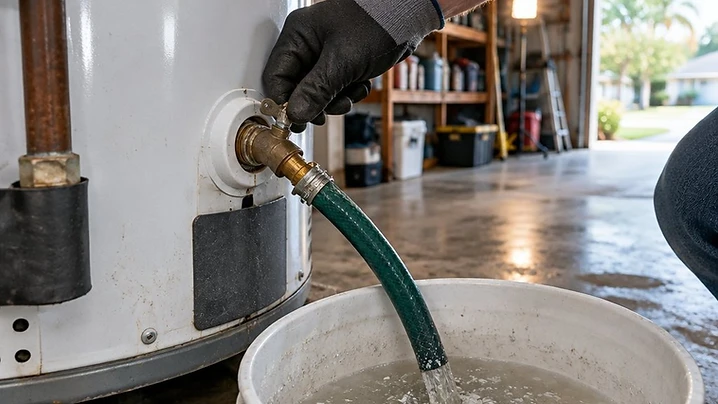
Flush the tank once a year. Draining off the sediment through the drain valve at the bottom takes about an hour on a tank that has been maintained and longer on one that has not. If it has been seven years and nobody has touched the valve, that valve may not close again, which is a real risk to know about before you open it.
Check the anode rod every few years. It is a sacrificial rod that corrodes so your tank does not. Once it is consumed, the tank starts sacrificing itself. Replacing a rod is far cheaper than replacing a heater.
Keep the thermostat sensible. Higher temperatures scale faster and increase scalding risk. Most households are fine in the standard residential range.
If you have very hard water and a heater that is already noisy, a softener or a powered descaler is worth pricing against what heaters cost.
Repair or replace
Repair makes sense when the problem is a failed element, a bad thermostat, a leaking T and P valve, or a pilot issue on an otherwise quiet tank. Replace makes sense when the tank itself is leaking, when the bottom is full of hardened sediment, when the heater is at the end of its expected life, or when you are paying to heat water through a layer of rock.
A leaking tank is not a repair. It is a replacement, and the leak does not get better while you think about it.
What we look at on a water heater call
We check the age, the water temperature at a tap, the burner or element behavior, the T and P valve and its discharge line, the flue on a gas unit, the expansion tank if there is one, and how much sediment we can pull out of the drain valve. Then we tell you what is worth doing and what is not.
No hot water, or a heater that sounds like it is full of gravel? Call (337) 258-4861.
Frequently Asked Questions
How often should a water heater be flushed in Lafayette?
Once a year is the right interval for our water. Homes with a softener can stretch it. Homes that have never flushed a heater more than a few years old should have it done carefully, because a drain valve that has sat closed for a decade can fail when it is opened.
Does hard water really shorten the life of a tank?
Yes. Scale insulates the heat source and holds moisture against steel at the bottom seam, which is where tanks usually fail. The damage is cumulative and mostly invisible until the tank leaks.
Is a softener worth it just for the water heater?
Rarely for the heater alone. It becomes worth it when you add up scale in the fixtures, spots on dishes and glass, soap that does not lather, and the heater. Look at the whole house, not one appliance.