Hydro Jetting vs. Snaking for Restaurant Grease Lines | Parish Plumbing
A home drain sees soap, hair and the occasional unfortunate toy. A restaurant drain sees animal fat, cooking oil, starch, food solids, and dish machine water at temperature, several hundred times a week. Those are different problems, and they need different tools.
If your kitchen line backs up on a Friday night and the answer is always the same snake, you are paying to reopen the same hole every few weeks. That is the pattern worth breaking.
What snaking does, and what it does not
A drain snake, or auger, is a rotating steel cable with a cutting head. It is an excellent tool and it is the right answer for a lot of problems: a soft blockage, a foreign object, a line you need open right now, and older fragile pipe where you do not want high pressure.
What a snake does is carve a channel. It punches through the middle of the blockage so water can pass. It does not clean the pipe wall. Grease does not sit in the middle of a line, it coats the inside like candle wax, and a snake slides straight through the coating and leaves most of it in place.
That channel is why the drain backs up again. New grease and food solids grab onto the remaining coating, the channel narrows, and the interval between calls gets shorter each time.
What hydro jetting does
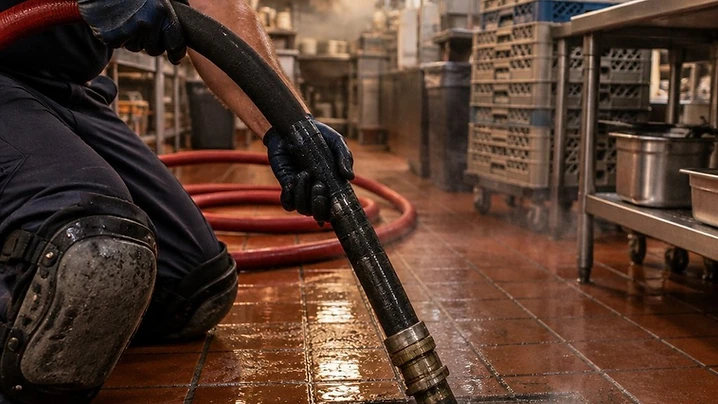
Hydro jetting uses a specialized nozzle on a high-pressure hose, with water forced out backward to pull the hose down the line and forward jets to scour the pipe wall in a 360-degree pattern. It is not a pressure washer pointed at a drain. It is a controlled tool with pressure and flow set to the pipe.
Done properly, it restores the pipe close to its original inside diameter. Grease, scale, sludge and root intrusion get flushed out, not bypassed, and the full flow capacity comes back.
The conditions that make it work: proper access, the right nozzle for the pipe size, the right pressure for the pipe material and condition, and a camera to confirm what you are jetting.
The rule we will not break
Nobody jets an old line blind. Cast iron and clay tile in a building that is 50 years old may be held together by scale. High-pressure water into a compromised pipe can turn a blockage into a collapse under the slab, and now the job is excavation.
Camera first, then jet. If the camera shows a broken pipe, a separated joint, or a belly where water sits, jetting is not the answer and we say so before the hose goes in.
When snaking is still right
- A sudden backup during service with no history, where the goal is to finish the night.
- A specific obstruction: a rag, a utensil, a piece of plastic.
- Fragile or already-damaged pipe where the camera says do not add pressure.
- Short runs and simple traps.
When jetting is right
- Repeat backups in the same line within weeks or months.
- Grease-heavy lines from a fryer bank, a three-compartment sink, or a dish machine.
- A camera view showing heavy wall coating.
- Root intrusion in an exterior lateral.
- As scheduled maintenance instead of emergency response.
That last one is the real argument. A restaurant that jets its grease line on a schedule is not paying for drain cleaning, it is buying the certainty that the line works during a Friday rush. One lost service night costs more than a year of scheduled maintenance.
The grease trap is the other half of the job
Jetting clears the pipe. It does not fix the reason the pipe filled. Grease trap pumping on the interval your volume actually requires, not the interval that feels adequate, is what keeps the line clear between services.
The rest is practice: no fryer oil down any drain, screens in floor sinks, a scrape-first station before the dish pit, and staff who know where the cleanout is and who to call when a floor drain starts rising.
What a service looks like for a commercial account
We camera the line, jet to a clean wall, camera again to verify, and document what we found with video you can keep. If there is a stopping point, a broken section, or a trap that needs pumping, you hear it from us before the work goes further.
Kitchen line backing up, or tired of the same recurring call? Call (337) 258-4861.
Frequently Asked Questions
How often should a restaurant jet its grease line?
It depends on volume, menu and trap discipline, not a fixed calendar. High-volume fried food operations often need it quarterly and sometimes more. The honest way to set the interval is to camera the line and watch how fast the coating returns.
Can hydro jetting damage old pipes?
It can if it is done blind at the wrong pressure. That is why the camera comes first and why pipe material and condition set the pressure. On sound pipe it is safe. On failing pipe the camera finds the problem before the water does.
Is jetting more expensive than snaking?
Per visit, usually yes. Per year, usually no, because a snaked line comes back. When you add the lost service nights and the emergency rates, scheduled jetting is generally the cheaper way to own a grease line.