Why Slab Leaks Cost More in Acadiana | Parish Plumbing
A slab leak is a leak in a water line running under your foundation. In most of the country that is a rare, expensive nuisance. In Acadiana it is a more common, more expensive nuisance, and the reason is geology, not bad luck.
The soil under your house is working against the pipe
A lot of Acadiana sits on clay-heavy soil. Clay does something sand and rock do not: it swells when it takes on water and shrinks when it dries out. Between our wet seasons and our dry ones, and between a soaked yard in June and a cracked yard in September, the ground under a slab moves. It does not move much in any given week. Over a decade it moves enough to matter.
A slab is rigid. The plumbing under it is rigid. When the ground beneath the slab shifts, the slab does not flex with it. It bridges, then it settles, then a seam or a joint in the copper or PEX underneath takes the strain. A pipe under tension does not leak the day it is installed. It leaks three years later, at two in the morning, under a floor you cannot lift.
Add the other thing Acadiana does well, which is water. High water tables, heavy rain in short windows, and yards that stay saturated for days all mean more pressure against the slab edge and more soil movement.
Slab-on-grade is the standard here, and that is the trade
Most homes built in Lafayette, Broussard, Youngsville and the surrounding towns in the last fifty years are slab-on-grade. No crawl space, no basement, no easy access to the plumbing under the living room. It is the right way to build on this soil for a lot of reasons, and thousands of homes here work exactly as designed for decades.
The tradeoff arrives the day a line under the slab fails. In a pier-and-beam house, a plumber crawls under and fixes the pipe. In a slab house, the pipe is under concrete, flooring, sometimes tile, sometimes a cabinet, sometimes the good rug in the hallway.
Why the bill runs higher here
Four things stack up.
Finding it. Water under a slab can surface ten feet from where it started. Guessing means breaking concrete in the wrong room. Proper detection narrows it to a spot: isolating the system, listening for the leak under pressure, thermal imaging, pressure testing the hot and cold sides separately. That work costs money, and it saves far more than it costs, because it is the difference between one cut and four.
Getting to it. Access is the expensive part. Options are a small breach in the slab at the leak, tunneling from the outside under the footing, or rerouting the line overhead through the attic or walls. Tunneling keeps your floors intact and costs labor. Breaking the slab saves labor and costs you a floor. Which one is right depends on where the leak sits, what is above it, and what your flooring is.
Repairing it. A spot repair on a copper line in clay soil is sometimes a fine answer and sometimes a bad one, because if the soil moved enough to break it once, the same stress sits on the rest of the run. That conversation is worth having honestly before anyone cuts concrete.
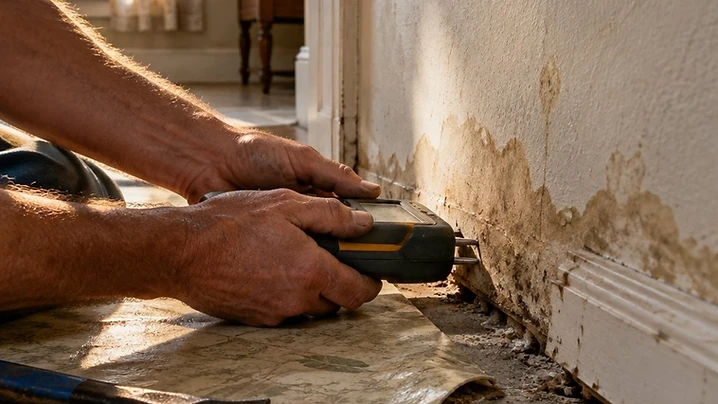
Putting it back. Slab patch, underlayment, matching flooring, baseboard, paint. Water that ran under vinyl or carpet for a week means drywall at the bottom of the wall is wet, and wet drywall grows things. Restoration is a real line item and it is why catching it early matters more than anything else in this article.
The signs, in the order they usually show up
- A warm spot on the floor. Hot water lines fail more often than cold, and a warm patch on tile or vinyl is the most reliable early sign there is.
- The sound of running water when nothing is running.
- A water bill that jumps without a change in habits.
- The meter test: shut off every fixture and appliance, then watch the meter. Movement means water is going somewhere.
- Damp carpet, cupped wood, or a baseboard that swells at the bottom.
- A musty smell that does not go away when you clean.
The warm spot and the meter test are the two you can do yourself in ten minutes.
What to do when you suspect one
Turn the water off at the main if you can see active water. Do not start pulling flooring to find it. Take photos and video of everything wet before anything is moved, because documentation is what claims are built on. Then get it located properly before anybody starts cutting.
Does insurance cover a slab leak?
Policies vary, and it matters that you read yours rather than trust a rule of thumb. The common pattern is that the water damage and the access may be treated differently from the pipe itself, and that long-term seepage, which is what an undetected slab leak is, is often excluded in a way sudden bursts are not. This is a conversation to have with your adjuster early, with documentation in hand, not after the floor is back down.
The least exciting advice in this article
Know where your main shutoff is, and test it once a year. Check your meter once a month. If your house is 25 years old or older and still has the original copper under the slab, a pressure test is cheap information.
If you think you have a leak under your floor, stop guessing. Call (337) 258-4861 and we will locate it before anything gets broken.
Frequently Asked Questions
How do I know if it is a slab leak and not a toilet?
A running toilet, a leaking supply line under a sink, and an irrigation break all move the meter too. Isolate first: shut off the fixtures one at a time, then the irrigation, then test the meter again. If the meter still moves with everything off inside, the leak is in the system under pressure.
Can you fix a slab leak without breaking my floor?
Often, yes. Tunneling from outside gets under the footing without touching the interior, and rerouting the line through the attic or walls avoids the slab entirely. Which one works depends on where the leak is and how the house is laid out. Some leaks are still a slab cut.
Will a slab leak damage my foundation?
The leak itself usually does not crack a slab. What water does over months is soften and move the soil that supports it, and that is when you see cracks in tile, doors that stick, or a floor that sounds hollow. Fixing the leak early is the cheapest foundation protection there is.